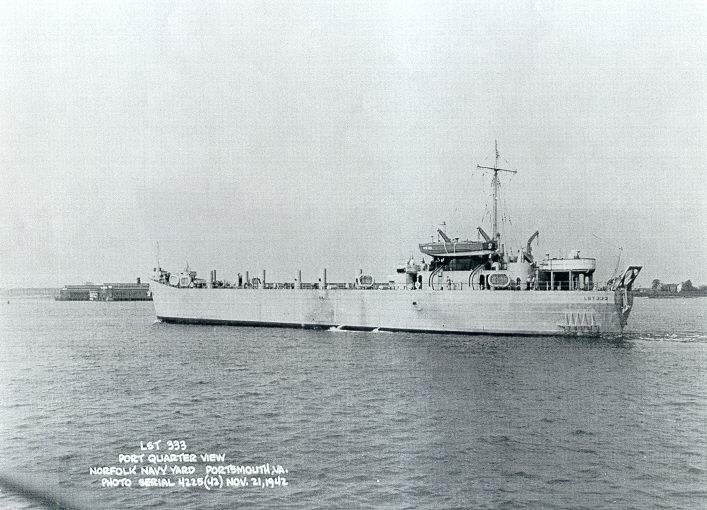
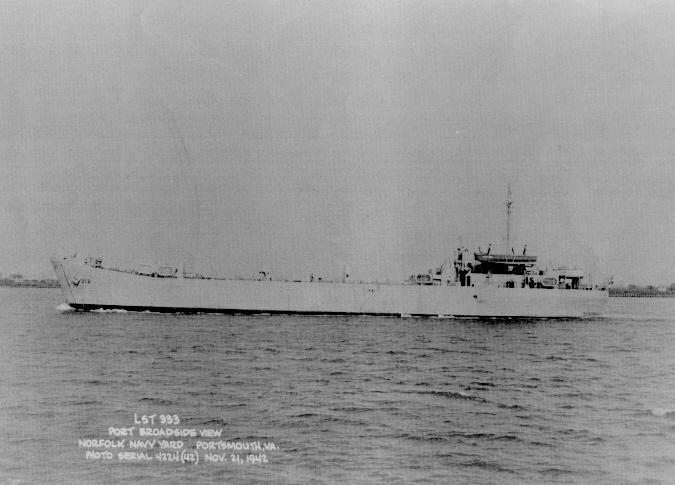
|
(One of the only 3 known Pictures to have survived of this heroic ship)
6. Having made certain that the ship was too badly damaged to save, the wounded became the next consideration. Twenty minutes had elapsed and I felt that there was little danger of further attack. A survey convinced me that the ship would remain afloat for a period of at least two hours, I therefore decided to attempt to beach for removal of the wounded, and salvage of equipment. The LCT's #244 and #19 were then passed lines, but, due to various mishaps, many lines were parted and progress was very slow. After about one hour, I became dubious of our chances of making the beach, and we were devising slings to place the wounded in the rafts, the SC 503 came close aboard and offered assistance. I directed her to tie up on our starboard side and take off our injured. This transfer was ably supervised by Lieut. I. Silverman, (MC), USNR, a C.B. passenger, with EATON, Charles F., Phm 1/c, USN, though badly wounded in the back, labored unceasingly during this operation, which continued until shortly before the vessel was beached, In this connection, too much credit cannot be given to the Captain and the Crew of the SC 503, where a ship's officer and an enlisted man formed a living bridge for walking wounded to pass over.
7. At 1000 hours. GCT, the water had come over the stern due to the break at frame #27, the after section of the ship was now sagging badly with water eight feet deep in the after section of the tank deck. All hands not engaged in the care and transfer of the wounded were moved forward to stand by the four life rafts, and the port landing boat which was undamaged was brought forward.
8. At this time, I was measuring our probable chances for remaining afloat against our rate of progress toward the beach, when the dark shape of a vessel appeared close inshore, but due to the lack of moonlight, it could not be made out. The forward guns were trained anticipating possible action from enemy submarines on the surface, as the water was quite deep close to shore. However, this unknown vessel turned about and drew away without coming closer.
9. It was now 2230 hours, GCT, on the 22nd, and the loading of the SC 503 was completed. I then ordered the sealed jettisoning bag containing our secret and confidential publications be placed on board in the custody of Lieut. (jg) Ansel H. Wilson, USNR, LST #333 Executive Officer, and dispatched that vessel for Algiers. At this moment the stern grounded.
10.Soundings showed five fathoms of water at frame #27, and fearing that the ledge on which the stern was resting might prove so acute that the strain might cause the after section to break off and slide into deep water, I determined on further measures. The two LCT's were brought alongside and secured port and starboard, and we proceeded to force the vessel further on the beach. By 2400, GCT, twenty feet of progress had been made and it became apparent that, while the stern was still sagging, no further progress could be made. The bow anchor was then dropped at 0045, GCT, I then ordered the exhausted survivors into the two LCT's, and beached closeby the vessel to await daylight. At 0715, I returned aboard and found that the stern was still settling very slowly. An officer an armed guard was placed in the landing boat alongside the vessel, and proceeded with the two LCT's to Dellys for food, water, and rest.
11. At 1330 hours, GCT, Captain Sullivan, USN, returned from inspection of the vessel, and gace me verbal orders to turn over the LST #333 to Lt. Comdr. A.H. Anderson, USN, for ComTaskFor #84, for purposes of salvage. At 1530, GCT, written orders were received, and, together with remaining survivors, proceeded by Army Truck Convoy to Algiers.
SUMMARY
12. Recognition should be given the Commanding Officers of the LCT's #244, #19, and to the SC 503, who so ably assisted me under the trying conditions of working a darkened ship, littered with wounded, dying, and the dead. Their speedy compliance with my every order made the beaching of the ship, and transfer of the wounded possible. Lieutenant H.M. Powell, (CEC), Lieutenant I. Silverman (MC), and Lieutenant (jg) J.R. Herbert, (CEC), of the C.B. Battalion passengers, the latter with a head wound, together with the ship's officers, functioned with cool efficiency throughout the ordeal. As to the remaining personeel of this vessel, they cannot be too highly commended; their discipline and fighting spirit did much to spur me, and make me disregard my minor personal injuries. The LST #333 had her remaining guns manned and was ready to do battle throughout the ordeal.
For additional information from the standpoint of Kapitänleutnant Gerd Kelbling, Commanding the U593 when she sunk the L.S.T. 333 during Convoy Elastic, read his official Operations log (translated) by CLICKING HERE. A new site will open in another window which, thanks to uboatarchive.net we can bring you this information!
(The third and rarest picture showing her leaving Portsmouth)
ARL-21 | ARSD-1 | ATF-85 | LST-333 PG1 | LST-333 PG2 | Main
© 2016 Tiger1 Productions, Ltd